
Website Redesign or Incremental Improvement: How to Decide
Should you rebuild your website from scratch or improve it iteratively? A practical framework for evaluating technical debt, content architecture and ROI.
By Pixel Primes Editorial Team
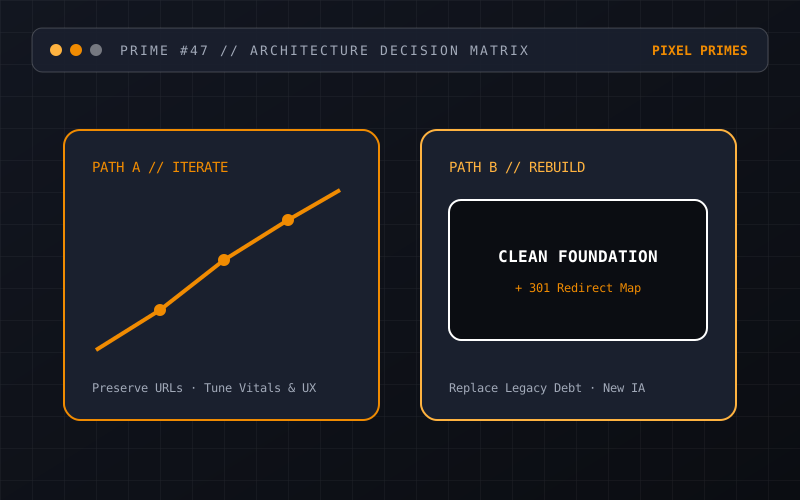
The temptation of the clean slate
When a website feels dated or difficult to update, tearing it down and starting over is tempting. A full rebuild promises a fresh visual identity and a clean codebase. Yet full redesigns also carry real cost, longer timelines and the risk of disrupting existing search rankings if URLs and content are changed carelessly.
Conversely, endlessly patching a fundamentally broken template can cost more over two years than replacing it once. Making the right call requires separating cosmetic dissatisfaction from structural failure.
When incremental improvement is the smarter path
If your underlying technology stack is modern, your URL structure is sound and your core brand positioning remains accurate, incremental evolution is almost always faster and lower-risk than a ground-up rebuild.
- →Targeted UX bottlenecks: Your traffic is healthy, but the contact form, navigation or service pages need clearer structure and better calls to action.
- →Performance & Accessibility gaps: Your templates look right, but need Core Web Vitals remediation, image optimisation or WCAG keyboard/contrast fixes.
- →Expanding content: You need to add new service detail pages, a blog architecture or cleaner CMS fields without discarding existing layouts.
When a full website redesign and rebuild is warranted
Sometimes the foundation itself is the blocker. A full Website Design and Development rebuild makes sense when incremental patches can no longer overcome architectural debt:
- →Fragile legacy stack: The site runs on an unsupported theme or tangled plugin chain where every small edit breaks another page.
- →Fundamental business pivot: Your company has shifted its core services, audience or brand identity so substantially that existing pages mislead buyers.
- →Inaccessible mobile & SEO structure: Heading hierarchies, mobile layouts and URL structures are so entangled that remediating templates one by one would take longer than building clean ones.
Protecting search equity whichever path you choose
Whether you rebuild or iterate, never discard working URLs silently. Map every existing indexed page before making structural changes, preserve proven search-intent copy, verify canonical tags and put clean 301 redirects in place wherever a slug must change. Combining disciplined Website Design and Development with ongoing Website Maintenance and Enhancements lets you modernise once and evolve smoothly thereafter.
Have a question about your project?
Talk directly with the designers and engineers at Pixel Primes Pty. Ltd.